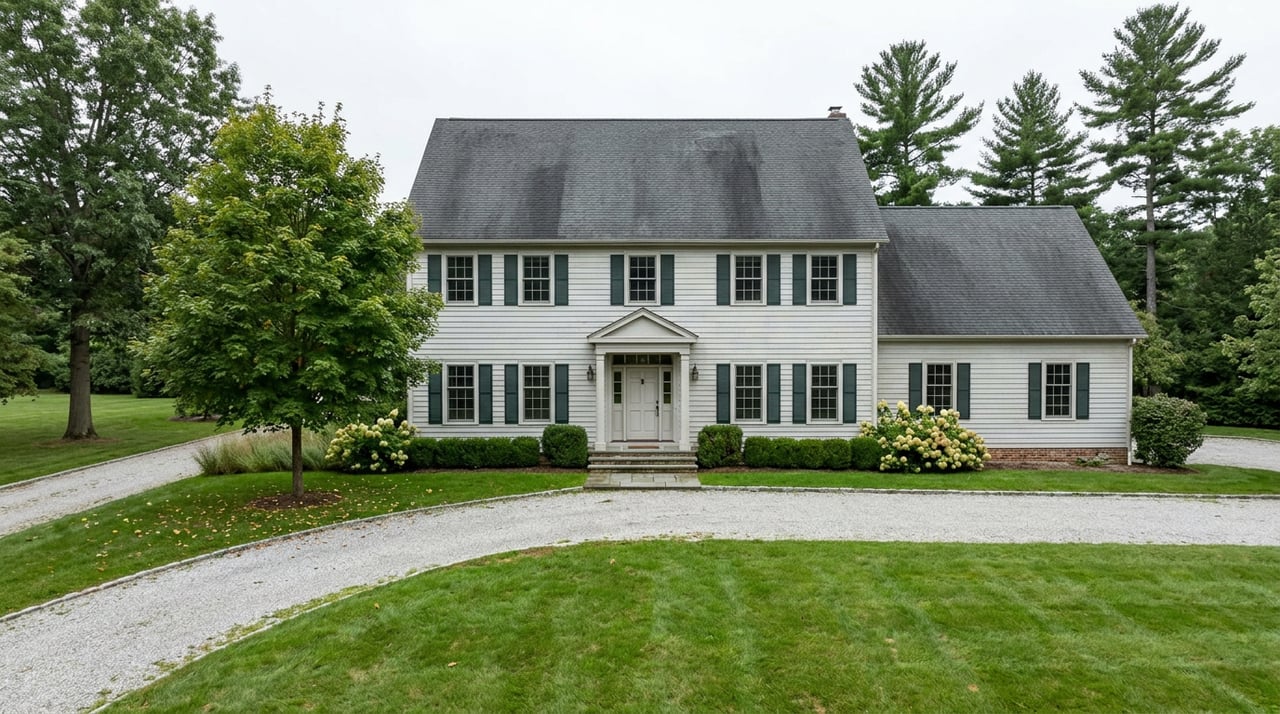
Picture a buyer's engineer walking a two-acre lot on the edge of Dover, tape measure in hand, about to deliver news the listing sheet never mentioned: the parcel doesn't qualify as a buildable lot under the town's zoning bylaw. On paper, Dover's zoning table on eCode360 sets two acres as the minimum for the R-2 district. But acreage alone was never the test. Dover's zoning FAQ says a lot must be able to contain what the bylaw calls a "perfect square," a hypothetical square measuring 200 feet on each side in an R-2 district, sitting entirely within the property. A long, narrow, or oddly shaped two-acre parcel can fail that test even though the total square footage clears the bar.
That single rule tells you more about how Dover actually functions than any median price ever will. This is a town that does not deal in approximate numbers. Every dimension gets measured, every exception gets a hearing, and nothing moves without a vote. Which is exactly why the biggest zoning change in Dover's modern history, a change that technically opened the door to multi-family housing for the first time, happened in a single evening, on a single parcel, with the vast majority of the town's estate-zoned land left completely untouched.
The Math Under the Acreage
Dover's residential zoning runs in three tiers. The R district requires a half acre and 100 feet of frontage. R-1 requires a full acre and 150 feet of frontage. R-2, which covers most of the town's largest and most private parcels, requires two acres and 200 feet of frontage. Layered on top of every tier is the perfect square requirement: a lot must be wide enough, at some point within its boundaries, to contain a square matching its district's frontage dimension. Dover's zoning code on eCode360 also excludes public and private ways, and any pond, river, or other body of water, from the lot area calculation altogether. No more than 25 percent of a lot's area can sit within the Conservancy District if that acreage is being counted toward the minimum. Shared driveways and curb cuts are not permitted at all.
None of this is exotic. It is standard large-lot zoning, and it is the reason Dover's estate character has held for decades. But it means a buyer touring a property advertised as "two-plus acres" is looking at a number that says nothing, on its own, about whether the lot can legally support a second home site, an accessory structure, or even a straightforward rebuild. The shape of the parcel and the location of its frontage matter as much as the total acreage.
The Vote Nobody Outside Dover Noticed
According to Westwood Minute, on September 29, 2025, Dover residents gathered at Mudge Auditorium inside Dover-Sherborn High School for a Special Town Meeting with a single article on the warrant. The town needed to comply with the state's MBTA Communities Act, a 2021 law requiring 177 cities and towns in the MBTA service area to zone at least one district where multi-family housing is allowed as of right. Dover has no train station and no bus route. Dover's MBTA Communities Act page identifies it as an "adjacent small town" because it borders a community that does have MBTA service, and gives towns in that category a December 31, 2025, compliance deadline.
The article passed 250 to 29. Dover's MBTA Communities Act page says the new zoning bylaw created a By-Right MBTA Communities Multi-Family Overlay District covering 9.957 acres at County Court, also known as Tisdale Drive. It is the only parcel in Dover where the new rule applies, and it was not chosen at random. County Court already has 56 existing multi-family units, and the neighboring Meadows development has 24 more. The town built its compliance strategy around ground that was already doing this kind of work rather than opening new territory to it.
Dover's planning team, working with outside land use consultant Horsley Witten Group, had spent roughly three years studying where a compliant district could go before narrowing the options down to this single site. Planning Board Chair Carol Lisbon and Town Planner Jasmin Farinacci ran public sessions throughout the spring, and the town held a public hearing on September 8, closed it, and sent a formal recommendation to Town Meeting three weeks before the vote.
What Was Actually on the Table
The financial argument for compliance carried real weight at the meeting. Board of Selectmen member Robyn Hunter told residents that Dover receives roughly $1.3 million a year in state grants tied to housing compliance, and that failing to pass a qualifying district would put that funding at risk, along with a separate $13 million earmark for replacing the town's Center Street Bridge. Her estimate: losing the annual grant money alone would add about $600 a year to the tax bill of a median Dover home, then valued around $1.6 million. Losing the bridge earmark on top of that would add another $425.
| If Dover had voted no | Estimated annual cost to the median homeowner |
|---|---|
| Loss of ~$1.3M in annual state grants | About $600 |
| Loss of $13M Center Street Bridge earmark | About $425 more |
| Combined | About $1,025 |
That math, more than any state mandate, is likely what moved 250 votes into the yes column. The law itself does not require Dover to build anything. It requires the town to zone capacity for it, and the town chose to concentrate that capacity on nine and a half acres that were already partway there.
What Changed and What Didn't
- Dover's base residential districts, R, R-1, and R-2, are unchanged. The two-acre minimum and the perfect square rule still govern the vast majority of the town's land.
- The new overlay applies only to the County Court and Tisdale Drive parcel. It does not extend to any other neighborhood or street in Dover.
- The law allows for a minimum of 102 units at a density of 15 units per acre within the overlay, but nothing requires that any of it gets built. A developer would still need to acquire the land and clear every normal permitting step, including site plan review.
- Dover's other land use protections, including its wetlands bylaw and Title V septic requirements, still apply inside the overlay. The MBTA Communities Act does not override them.
The Pattern Buyers Should Actually Take From This
Dover's response to a state housing mandate looked exactly like its response to a two-acre lot that fails the perfect square test. The town didn't improvise. It measured, it hired a specialist, it held hearings, it ran the numbers on what noncompliance would cost, and then it voted on the narrowest possible version of change that satisfied the law.
For a buyer comparing Dover to Wellesley, Needham, or Sherborn, that pattern is the real signal. Dover's zoning isn't frozen, but it also isn't drifting. That predictability cuts both ways. It means the R-2 estate districts that define the town are unlikely to see quiet erosion. It also means anyone hoping to develop a Dover property outside the lines, whether that's a lot split, a shared driveway, or a structure that brushes against the wetlands buffer, should expect the same level of scrutiny that produced a 9.957-acre overlay after three years of study.
A Few Questions Worth Asking Before You Tour
Does this overlay affect property values anywhere else in Dover? No. It is confined to the County Court and Tisdale Drive parcel, and Dover's base zoning outside that district is unchanged.
If I'm buying land and the listing says "two acres," is that enough to build? Not necessarily. Confirm the lot can contain the required perfect square for its district and that it has qualifying frontage on an accepted way. A civil engineer or land use attorney familiar with Dover's Chapter 185 zoning bylaw can check this before you're under contract.
Dover rewards buyers and sellers who understand its rules at the level of frontage, perfect squares, and Conservancy District percentages, not just acreage and asking price. If you're evaluating a Dover property, whether it's an estate parcel, a potential subdivision, or land anywhere near the new overlay district, Mary Crane Properties has spent decades working through exactly this kind of technical terrain with sellers and buyers across town. Schedule a confidential consultation with Mary before you make an offer that depends on numbers a tax map can't tell you.
This article is general information, not legal, tax or financial advice. Consult a qualified professional about your situation.